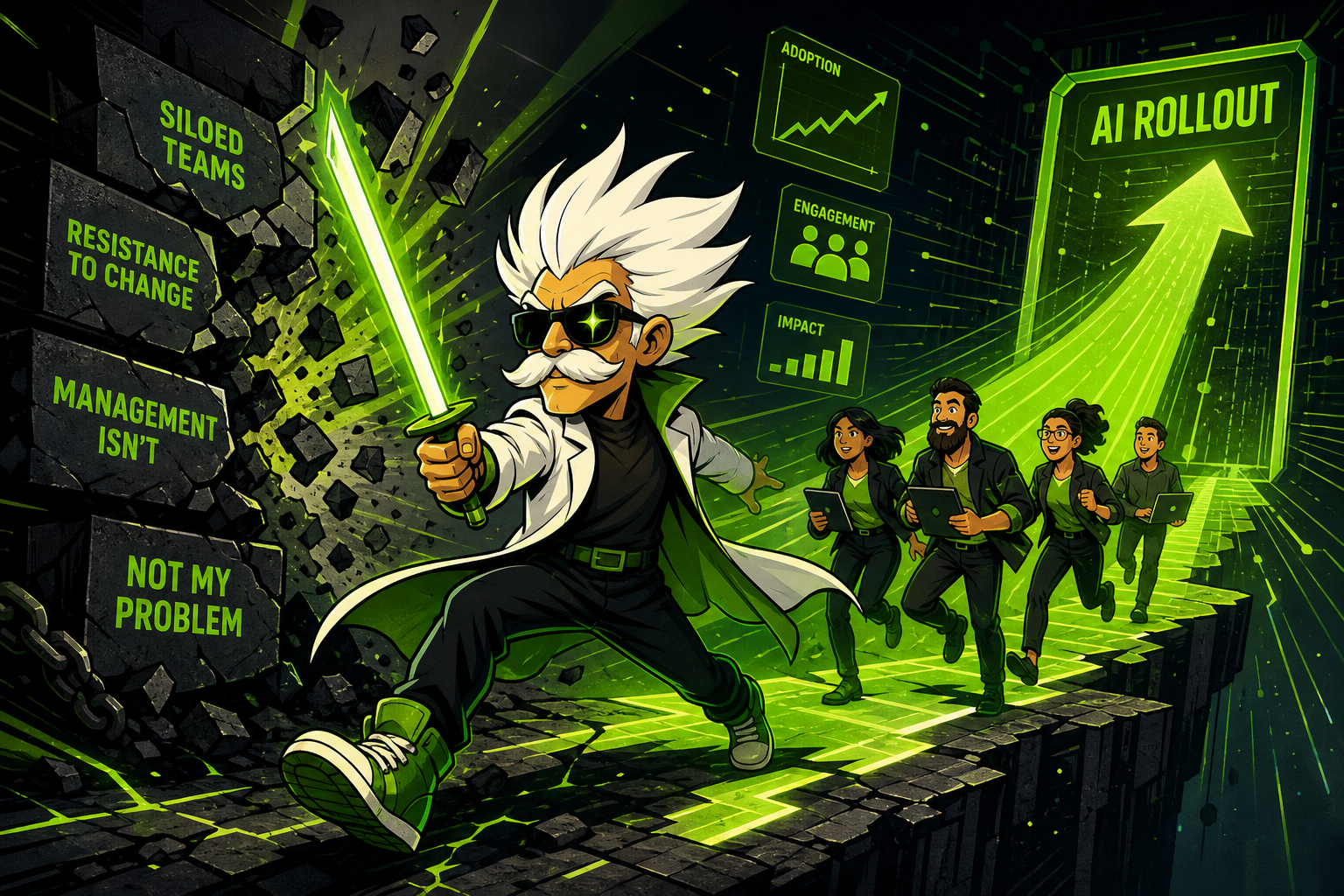
The Assumption That Breaks AI Rollouts
Most leaders approach an AI tool rollout the same way they approach a new software implementation: brief the team, set a go-live date, and assume adoption follows. It doesn't. And the reason it doesn't has almost nothing to do with the technology. When RogIQ was first rolled out internally at Haley Marketing, the team didn't embrace it. They pushed back hard. They didn't give it a real chance. They expected a finished, polished product, and when they encountered the natural imperfections of a v1 build, the resistance crystallized fast. The lesson wasn't about the product. It was about what happens when leaders underestimate the human cost of change, and overestimate how much a rollout plan can substitute for genuine change management.
We Are Biologically Wired to Resist This
This isn't a management cliché. It's physiology. Humans are wired for homeostasis, the biological drive to maintain a stable, familiar state. Change, by definition, disrupts that. And in a post-pandemic environment where trust in institutions, employers, and systems has eroded significantly, people push back harder and faster than they might have five years ago. AI amplifies this dynamic because it doesn't just change a workflow. It changes the nature of the work itself, what skills matter, what a "good" output looks like, what a person's role actually contributes. That's not a software update. That's an identity-level disruption. Leaders who miss this dynamic spend months wondering why the tool isn't being used, when the real question is why they expected a training session to resolve an existential concern.
The Leadership Mistake That Quietly Kills Adoption
Here's the most common mistake: leaders delegate the AI problem to technology or operations, then check back in three months expecting a different culture. If you're not using the tool yourself, daily, visibly, imperfectly, you are not modeling the behavior you're asking for. And if you're not modeling it, you have no standing to expect it. This matters more than most leaders want to admit. Teams watch what their leaders actually do, not what they announce. If the AI tool appears in the all-hands presentation but never in the leader's actual workflow, the message received is clear: this is something we're supposed to say we're doing, not something we're actually doing. The stronger approach is uncomfortable but straightforward: get in the tool, make mistakes publicly, talk about what works and what doesn't, and let your team see that you're figuring it out alongside them. If you're not willing to learn, why would your team learn? The question answers itself.
What Actually Moves People Through Change
There are three actions that, done consistently, shift team behavior more reliably than any policy or mandate.
1. Acknowledge the Fear Directly
Don't manage around resistance. Name it. Tell the team that you know this is a significant change, that you understand the uncertainty is uncomfortable, and that their concern is legitimate, not a performance issue. Acknowledging fear doesn't validate paralysis. It removes the energy people spend hiding their discomfort, and it opens space for a more honest conversation about what they actually need to move forward.
2. Reframe the Cost of Staying the Same
Change management research consistently shows that people change when the pain of staying still becomes greater than the pain of moving. Inspiration and enthusiasm rarely drive sustained behavior change. Clear-eyed honesty about what the status quo actually costs does. Staying the same is more painful than the change, but most people won't reach that conclusion on their own. Leaders have to help them see it. For AI specifically, that means being honest about what the competitive landscape looks like for companies that don't adapt, what it costs in capacity and opportunity to continue operating without leverage, and what the alternative to learning looks like in two or three years.
3. Celebrate the Right Behaviors Loudly
This is where most change initiatives fall short. Leaders announce the change, address the fear once, and then move on, assuming momentum will carry things forward. It won't. Behavior change requires sustained reinforcement. That means publicly recognizing the people who are trying, even when the output is imperfect. It means celebrating the failure that taught you something, not just the win that looked clean. It means making the new behavior visible, rewarded, and socially safe to adopt. When someone on the team steps into an uncomfortable new workflow and shares what they learned, that moment is worth more to adoption than any demo or training session. Amplify it.
The Honest Position Leaders Have to Hold
Here's the hardest part of leading an AI transition right now: you don't have all the answers. The category is moving too fast. The full picture isn't clear. And your team wants certainty you can't honestly provide. The temptation is to project confidence you don't feel, or to avoid the conversation until you have more clarity. Both of these approaches erode trust faster than uncertainty does. The stronger position is to say, clearly and repeatedly: We don't have all the answers. We know this is a significant change. We are committed to figuring it out, and to bringing you with us as we do. That's not a weak position. In an environment of radical change, it's the only credible one.
The Bottom Line
AI rollouts that fail aren't usually failing because the technology is wrong. They're failing because the change management is missing, or because leaders assumed technology change and behavior change are the same thing. They're not. The technology can be excellent and the adoption can still collapse if the human layer, fear, identity, credibility, trust, isn't actively managed. Lead the change. Model the behavior. Acknowledge the fear. Reinforce relentlessly. The tool is only as powerful as the culture that's willing to use it.
Contact us today