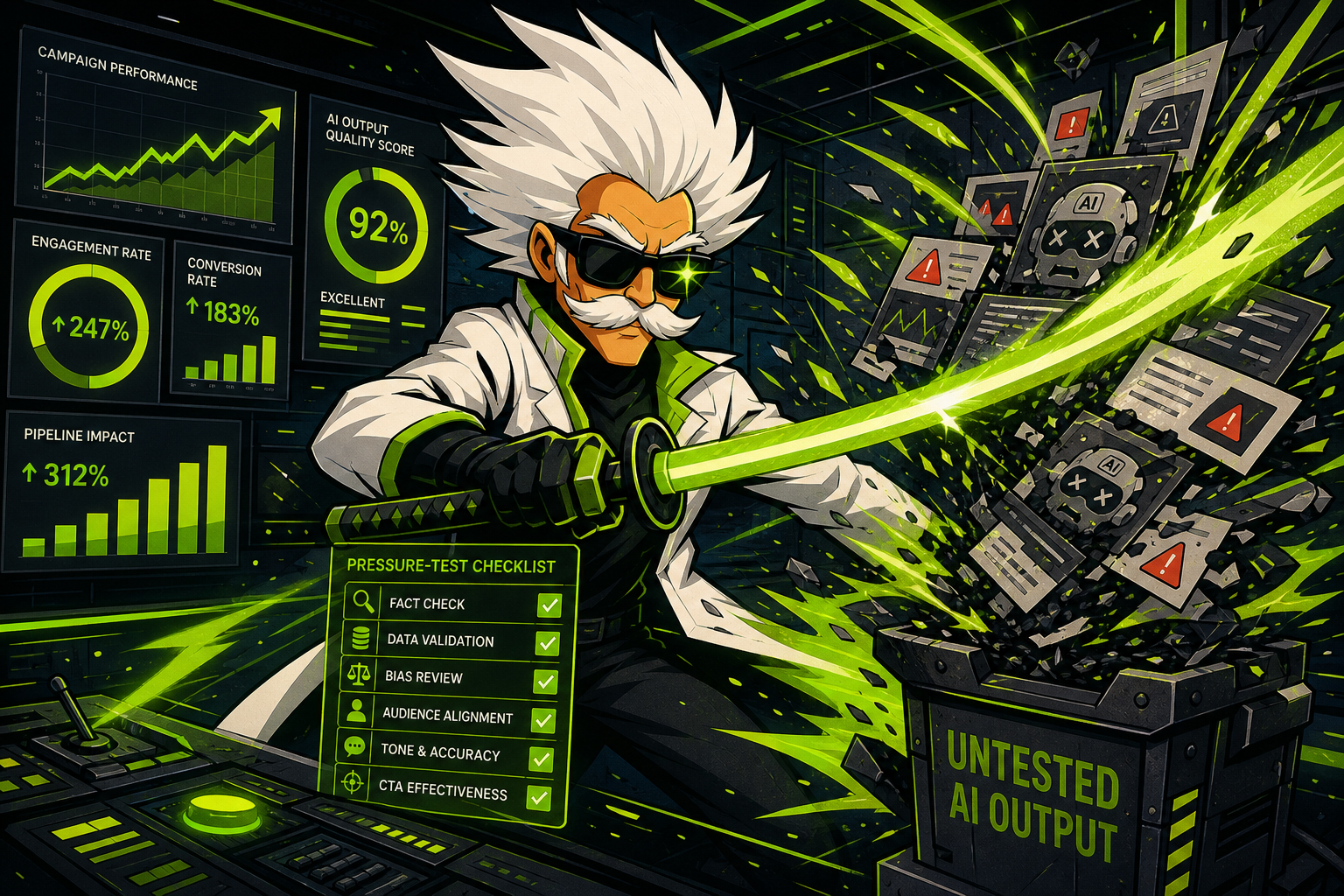
How to Pressure-Test Your AI Marketing Output Without Sacrificing Speed
As AI continues to reshape marketing strategies, ensuring the quality of AI-generated content becomes essential. This guide is designed for marketing managers and content teams eager to harness AI's capabilities without compromising on credibility or speed. By applying practical methods to pressure-test AI marketing output, you can confidently integrate AI into your campaigns, ensuring that your content resonates with your audience and upholds your brand’s standards. Let’s explore how to balance efficiency with reliability in your AI-driven marketing efforts.
1) Define clear success criteria for AI outputs
Before running tests, specify what constitutes acceptable performance. Establish measurable benchmarks for accuracy, brand voice consistency, factual correctness, and alignment with audience expectations. Use concrete examples from past campaigns to set these thresholds. Practitioners in this field often rely on a simple checklist: accuracy, tone, relevance, and timeliness.
2) Build a reproducible testing framework
Create a standardized process for evaluating AI results. Include input prompts, expected outcomes, evaluation rubrics, and a review workflow. A reproducible framework enables you to compare iterations over time and spot regressions quickly. Remember to document any prompts that produce undesirable biases or off-brand language.
2.1 Develop evaluation rubrics
Factual accuracy: verify claims with credible sources.
Brand alignment: check tone, voice, and style guidelines.
Relevance: ensure content targets the intended audience and purpose.
Engagement potential: estimate reader interest and actionability.
3) Use staged checks that scale with speed
Design a tiered testing approach that matches your production pace. Start with quick, automated checks for obvious errors, then escalate to human review for nuanced judgments. This keeps volume high without sacrificing quality.
3.1 Automated quick checks
Spell and grammar validation
Plagiarism and originality scans
Consistency with brand voice using a style classifier
3.2 Human-in-the-loop reviews
Subject-matter experts verify factual claims
Editors assess tone and audience fit
Compliance checks for regulatory or platform requirements
4) Implement a feedback loop to close the loop fast
Capture reviewer feedback in a centralized system and tie it back to specific prompts and models. Use this data to refine prompts, guardrails, and post-processing rules. Over time, you’ll reduce the need for rework and accelerate iteration cycles.
5) Apply versioning and provenance
Track model versions, prompts, and test results so you can reproduce outcomes or roll back to a known-good state. Provenance builds trust with stakeholders and supports auditing for compliance or editorial standards.
6) Manage drift and bias proactively
Monitor for drift in AI outputs as models update or prompts evolve. Regularly test for bias or safety issues and adjust prompts or filters accordingly. Proactive governance helps maintain long-term reliability without slowing momentum.
7) Align speed with publish-ready readiness
Set explicit thresholds for when content is ready to publish versus when it needs additional review. Define acceptance criteria, escalation paths, and estimated turnaround times so teams know what to expect at every stage.
8) Integrate with existing workflows
Embed AI checks into your current editorial and publishing pipelines. Use automation to trigger checks at key milestones and route content to the right reviewers without creating bottlenecks.
9) Plan for different content formats
Adapt pressure-testing practices to blogs, social posts, emails, and landing pages. Each format has unique risk profiles, so tailor evaluation criteria accordingly and reuse tests where possible to save time.
10) Measure impact and iterate
Track outcomes such as engagement, click-through rates, and conversion events to gauge the real-world effectiveness of AI-generated content. Use insights to refine prompts, models, and workflows for next cycles.
Start by documenting your AI prompts and the types of content you typically create. Then, develop a quick rubric that allows you to identify high-risk content in about ten minutes per piece, helping you pressure-test AI marketing output effectively. This process speeds up your workflow while maintaining quality. Assign a content lead to oversee final publishing decisions and establish a fast track for addressing any issues that arise. This structure helps your team stay agile while ensuring credibility.
Contact us today