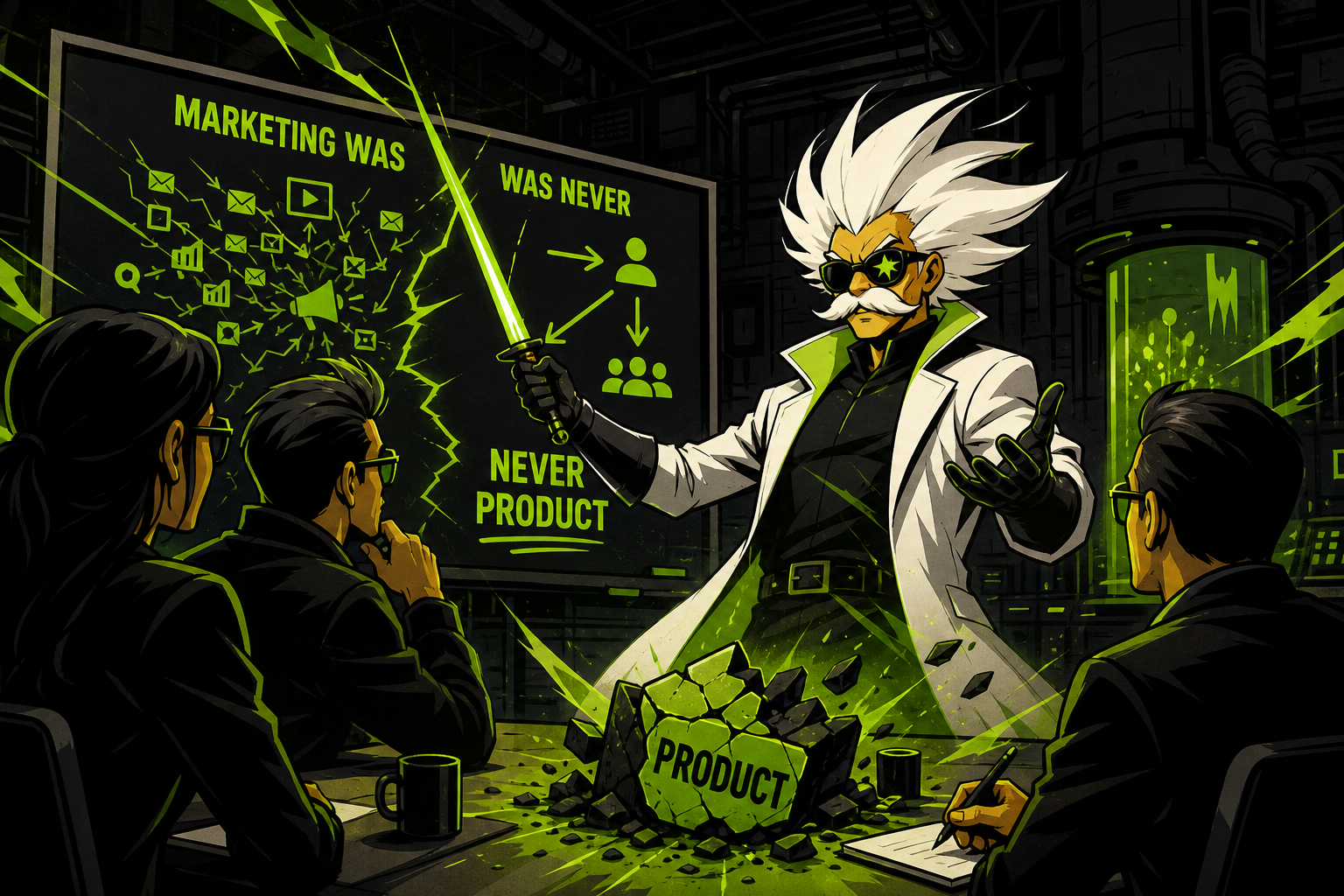
Marketing Was Never the Product
Looking back, I realized our clients weren't buying websites, SEO, content, or AI. They were investing in growth.
Looking back, I realized our clients weren't buying websites, SEO, content, or AI. They were investing in growth.
Looking back, I realized our clients weren't buying websites, SEO, content, or AI. They were investing in growth.
If someone had asked me twenty years ago what business we were in, I probably would have answered without hesitation.
"We're a marketing agency."
At the time, that seemed like the obvious answer. We built websites, developed marketing campaigns, wrote content, improved SEO, created videos, launched email campaigns, and helped businesses communicate more effectively with their customers. Every day our team was producing marketing, so naturally I assumed marketing was the product we were selling.
Looking back, I don't think that was ever entirely true.
Over the years, I've had the privilege of working with hundreds of business owners. They represented different industries, different markets, and businesses of every size imaginable. While their companies and challenges were often very different, I eventually realized they all had something in common.
None of them came to us because they wanted marketing.
They came to us because they wanted growth.
Some wanted more qualified leads. Others wanted to enter new markets, launch a new service, strengthen their reputation, or compete more effectively against larger competitors. Some were trying to attract better employees. Others wanted to build a more recognizable brand or generate more consistent revenue. Every client defined success a little differently, but the underlying objective was remarkably consistent.
They wanted to build a better business.
Marketing was simply one of the ways we helped them get there.
That realization didn't happen overnight. It emerged gradually through thousands of conversations with business owners who cared far more about business outcomes than marketing tactics. They weren't investing in a new website because they wanted a new website. They wanted more opportunities. They weren't asking about SEO because they were fascinated by search rankings. They wanted customers to find them before they found a competitor. They weren't interested in publishing content for the sake of publishing content. They wanted to become the company people trusted when it was time to make a buying decision.
The more I listened, the more I realized we weren't really in the marketing business.
We were in the business growth business.
That subtle shift in perspective changed the way I thought about almost everything.
Instead of asking, "What new service should we offer?" we started asking, "What new challenges are our clients trying to solve?" Those are very different questions. One begins with your business. The other begins with theirs.
Looking back, I think that explains why our agency continued evolving over the past three decades. Every few years the marketing landscape changed. New technologies emerged. New channels became important. Buyer behavior shifted. Search engines evolved. Social media transformed communication. Marketing automation became mainstream. Artificial intelligence arrived.
From the outside, it might have looked like we were constantly expanding our services or chasing the next trend.
It never felt that way from inside the business.
The mission never changed.
We were simply finding better ways to help our clients grow.
That's an important distinction because it changes how you evaluate innovation. If you believe you're in the business of selling marketing services, every new technology feels like a threat. If you're in the business of helping clients grow, every new technology becomes another opportunity to create value.
That's exactly how I viewed artificial intelligence.
When AI became the biggest conversation in marketing, many people immediately asked what it might replace. Could it replace writers? Designers? Strategists? Agencies?
Those are understandable questions, but they weren't the questions that interested me.
I kept coming back to the same question we'd been asking for years.
Can this help our clients grow in a repeatable way?
If AI could help businesses improve their visibility, generate more qualified leads, strengthen customer relationships, and make better marketing decisions, then it deserved our attention. If it could help experienced marketers spend less time on repetitive tasks and more time thinking strategically, then it wasn't replacing expertise. It was amplifying it.
That philosophy shaped every decision we made.
Looking back, I don't think AI changed our direction.
It accelerated it.
Over the years we had invested in better systems, better processes, better frameworks, and better ways to capture the knowledge we'd accumulated through decades of serving clients. We weren't trying to build software. We were trying to build a better business. Artificial intelligence simply created an opportunity to bring those ideas together in a way that hadn't been possible before.
That's really where RogIQ came from.
Not from a desire to build another AI platform, but from a belief that agencies and businesses needed a better way to turn experience into execution. A better way to combine strategy, knowledge, technology, and consistency so marketing teams could spend less time producing and more time helping clients succeed.
When people ask me what RogIQ is, I certainly describe its features and capabilities.
But if you asked me what RogIQ really represents, my answer would be much simpler.
It's thirty years of continually asking one question.
How can we help our clients grow in a repeatable way?
The technology will continue to evolve. Five years from now we'll almost certainly be using tools that don't exist today. Marketing channels will change, buyer behavior will continue to evolve, and artificial intelligence will become more capable than any of us can imagine.
None of that changes the mission.
Businesses will always need to grow.
They'll always need to earn trust, attract customers, differentiate themselves, and create value. The tools we use to help them accomplish those goals will continue changing, just as they have for the past thirty years.
If there's one lesson I'd pass along to another agency owner, it's this: don't become too attached to the services you offer today. Instead, become relentlessly committed to the outcomes your clients are trying to achieve.
Services evolve.
Technology evolves.
Businesses that remain focused on solving meaningful problems evolve with them.
Looking back, I don't think marketing was ever really the product.
Helping businesses grow was.
Everything else, including RogIQ, is simply another chapter in that story.
One of the reasons I'm writing the Agency Evolution Series is because I believe the most valuable lessons in business rarely come from a single breakthrough. They come from years of working with clients, adapting to change, making mistakes, challenging assumptions, and continually looking for better ways to create value.
If this article resonates with you, I hope you'll continue exploring the series. And if it causes you to think differently about your own agency, your clients, or the future you're trying to build, then it has accomplished exactly what I hoped it would.
I'd also welcome the opportunity to continue the conversation. Every agency has its own story, but I suspect we're all asking the same question:
How do we build a business that's even better tomorrow than it is today?
See how RogIQ fits your business.
Schedule a Partner Demo